
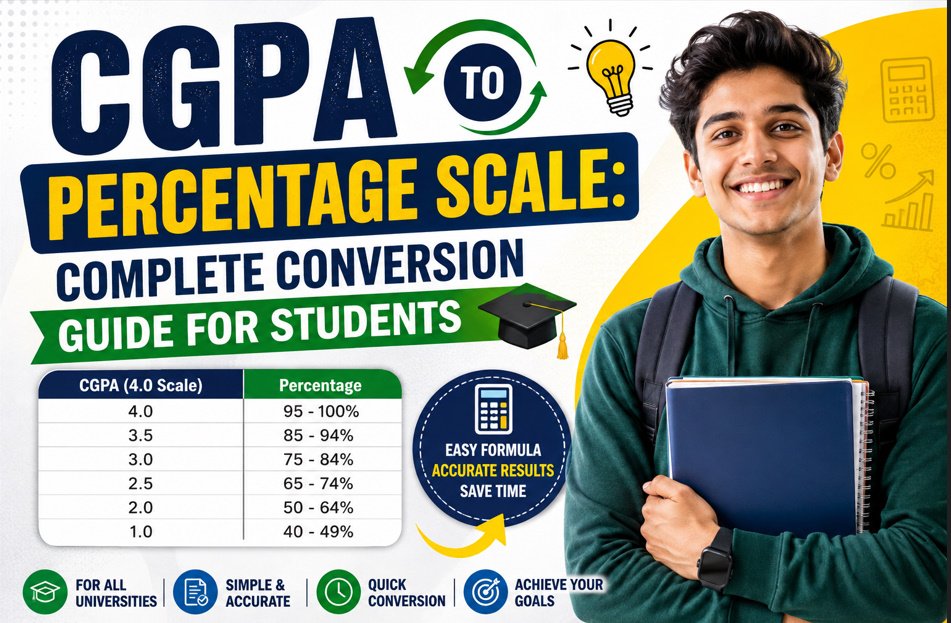
CGPA to Percentage Scale
A CGPA to Percentage Scale helps students convert their Cumulative Grade Point Average (CGPA) into a percentage. Many universities, colleges, employers, and scholarship organizations ask applicants to submit percentage marks instead of CGPA. Understanding the correct conversion method ensures your academic performance is presented accurately.
Different educational boards and universities use different conversion formulas. Some multiply CGPA by a fixed number, while others follow their own grading policy. Therefore, students should always verify the official conversion method before submitting applications. This guide explains everything in simple language using practical examples.
Key Points
- CGPA means Cumulative Grade Point Average.
- Percentage represents marks out of 100.
- Every university may use a different formula.
- Official conversion should always be preferred.
- Used for admissions and jobs.
- Required for scholarships.
- Helps compare academic performance.
- Easy to calculate with the correct formula.
What Is CGPA?
CGPA stands for Cumulative Grade Point Average, which measures a student’s overall academic performance across multiple semesters or years. Instead of showing total marks, CGPA represents the average of grade points earned in all completed courses. It provides a simplified way to evaluate student achievement.
Many schools, colleges, and universities worldwide use CGPA because it reduces pressure caused by percentage-based marking systems. It also makes it easier to compare academic performance across different subjects. However, when institutions require percentages, students must convert their CGPA using an approved formula.
Key Points
- Full form is Cumulative Grade Point Average.
- Represents average academic performance.
- Based on grade points.
- Covers multiple semesters.
- Used worldwide.
- Easy grading system.
- Accepted by many universities.
- Can be converted into percentage.
Why Convert CGPA to Percentage?
Many employers, universities, competitive exams, and scholarship providers request academic percentages instead of CGPA. Converting your CGPA into percentage helps meet these application requirements and ensures your academic records are accepted without confusion.
Percentage scores are also easier for organizations to compare across candidates from different educational systems. Using the correct CGPA to percentage conversion improves transparency and prevents mistakes that could affect admissions, placements, or higher education opportunities.
Key Points
- Required for admissions.
- Needed for government jobs.
- Used in scholarships.
- Helpful for competitive exams.
- Makes comparison easier.
- Converts grades into marks.
- Supports international applications.
- Improves document clarity.
Common CGPA to Percentage Formula
One of the most common conversion methods is:
Percentage = CGPA × 9.5
For example, if your CGPA is 8.2, your percentage becomes:
8.2 × 9.5 = 77.9%
Although this formula is widely used, it does not apply to every institution. Some universities multiply by 10, 9.25, 9, or another value based on their own grading regulations. Always verify the official academic guidelines before calculating your final percentage.
Key Points
- Percentage = CGPA × Conversion Factor.
- 9.5 is a common multiplier.
- Formula varies by university.
- Check official rules.
- Use accurate values.
- Calculate carefully.
- Round only if instructed.
- Verify before submission.
CGPA to Percentage Conversion Examples
Understanding conversion becomes easier with practical examples. If a university follows the 9.5 formula, a CGPA of 7.5 equals 71.25%, while a CGPA of 9.0 becomes 85.5%. These examples help students calculate results quickly.
Different institutions may produce different percentages for the same CGPA because they use different conversion factors. Therefore, always use your university’s official formula instead of relying on online assumptions.
Key Points
- 6.5 CGPA = 61.75% (×9.5)
- 7.0 CGPA = 66.5%
- 7.5 CGPA = 71.25%
- 8.0 CGPA = 76%
- 8.5 CGPA = 80.75%
- 9.0 CGPA = 85.5%
- 9.5 CGPA = 90.25%
- Formula may differ.
University-Specific CGPA Conversion Methods
Many universities publish their own CGPA to percentage conversion policy. Engineering universities, medical colleges, business schools, and international institutions often use different grading scales. Some provide official conversion certificates for students applying abroad.
Before converting your CGPA, visit your university’s academic regulations or examination department. Using the wrong formula may lead to incorrect academic records and delays in admissions or recruitment.
Key Points
- Universities follow different rules.
- Official formulas should be used.
- Some issue conversion certificates.
- International standards vary.
- Engineering colleges differ.
- Medical institutions have unique scales.
- Check examination office.
- Read academic handbook.
Tips for Accurate CGPA to Percentage Conversion
Always confirm whether your institution requires an official conversion formula or simply accepts CGPA. Double-check calculations before filling admission forms or job applications. Small mistakes can affect eligibility in competitive programs.
Using an online CGPA to Percentage Calculator can reduce calculation errors and save time. However, students should compare the calculator’s formula with official university guidelines to ensure accurate results.
Key Points
- Verify official formula.
- Check calculations twice.
- Use trusted calculators.
- Read university policy.
- Keep academic records.
- Avoid unofficial formulas.
- Round carefully.
- Save conversion proof.
Frequently Asked Questions About CGPA to Percentage Scale
Students often ask whether every CGPA can be multiplied by 9.5. The answer is no. Different educational institutions use different conversion methods. Some even calculate percentages using subject-wise grades instead of a fixed multiplier.
Another common question is whether employers accept CGPA directly. Many organizations accept CGPA, while others specifically request percentages. Always read the eligibility criteria before submitting academic documents.
Key Points
- Not every university uses 9.5.
- Official rules are important.
- Employers may request percentage.
- Scholarships may require conversion.
- International universities differ.
- Check eligibility criteria.
- Use official documents.
- Ask examination office if unsure.
Conclusion
The CGPA to Percentage Scale is an essential academic conversion method used by schools, colleges, universities, employers, and scholarship organizations. Knowing the correct conversion formula helps students present their academic achievements accurately and confidently.
Since conversion methods vary across institutions, always use your university’s official formula instead of relying on generic calculations. Whether you are applying for higher education, competitive exams, internships, or jobs, an accurate CGPA-to-percentage conversion ensures your academic profile remains reliable, professional, and widely accepted.